
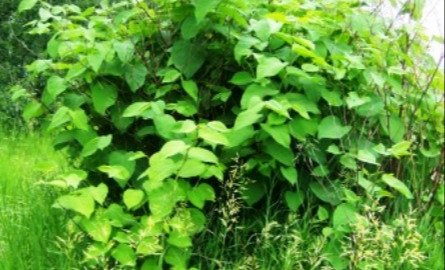
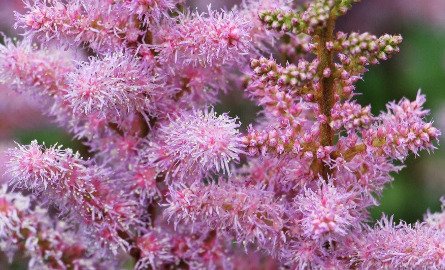
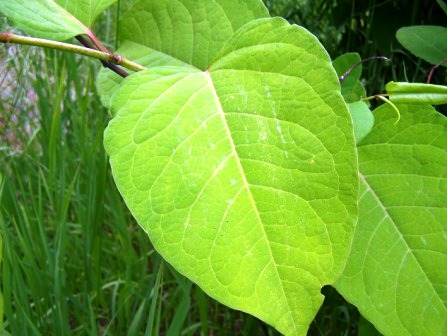
Latin Name: Polygonum spp, Fallopia spp.
Physical Description: These perennial forb species are originally from eastern Asia. They were introduced to Europe and North America as ornamentals in the early 1800s and are listed as one of the worst 100 invasive plant species by the World Conservation Union. Bohemian knotweed is an aggressive and adaptable hybrid between Japanese and giant knotweeds and is probably the most common of the invasive knotweeds in British Columbia, although the other three species are also causing problems.
All four species have a similar appearance and are difficult to distinguish in the field. Himalayan knotweed has pinkish-white flowers while the other three species have greenish-white flowers. All four species have hollow reddish bamboo-like stems, large broad leaves, and rhizomatous roots. Giant knotweed can grow to 6 m, Japanese knotweed to 4 m, and Himalayan to 3 m tall.
Type: Perennial forb
Habitat & Impacts: These species grow in a wide range of open sites but do not tolerate shade. It is most common in moist low-lying sites but can also tolerate extreme heat and drought. The knotweeds form dense stands and may virtually eliminate other vegetation on a site.
Method of Spread: The main form of reproduction is vegetative with new shoots forming from underground rhizomes or root fragments.
