The majority of properties in the Deka Lake area are zoned Residential 1 (R1) under South Cariboo Area Zoning Bylaw No. 3501.
Deka Lake Residential Zoning Information and FAQs
Residential Zoning Information Available for Deka Lake Residents
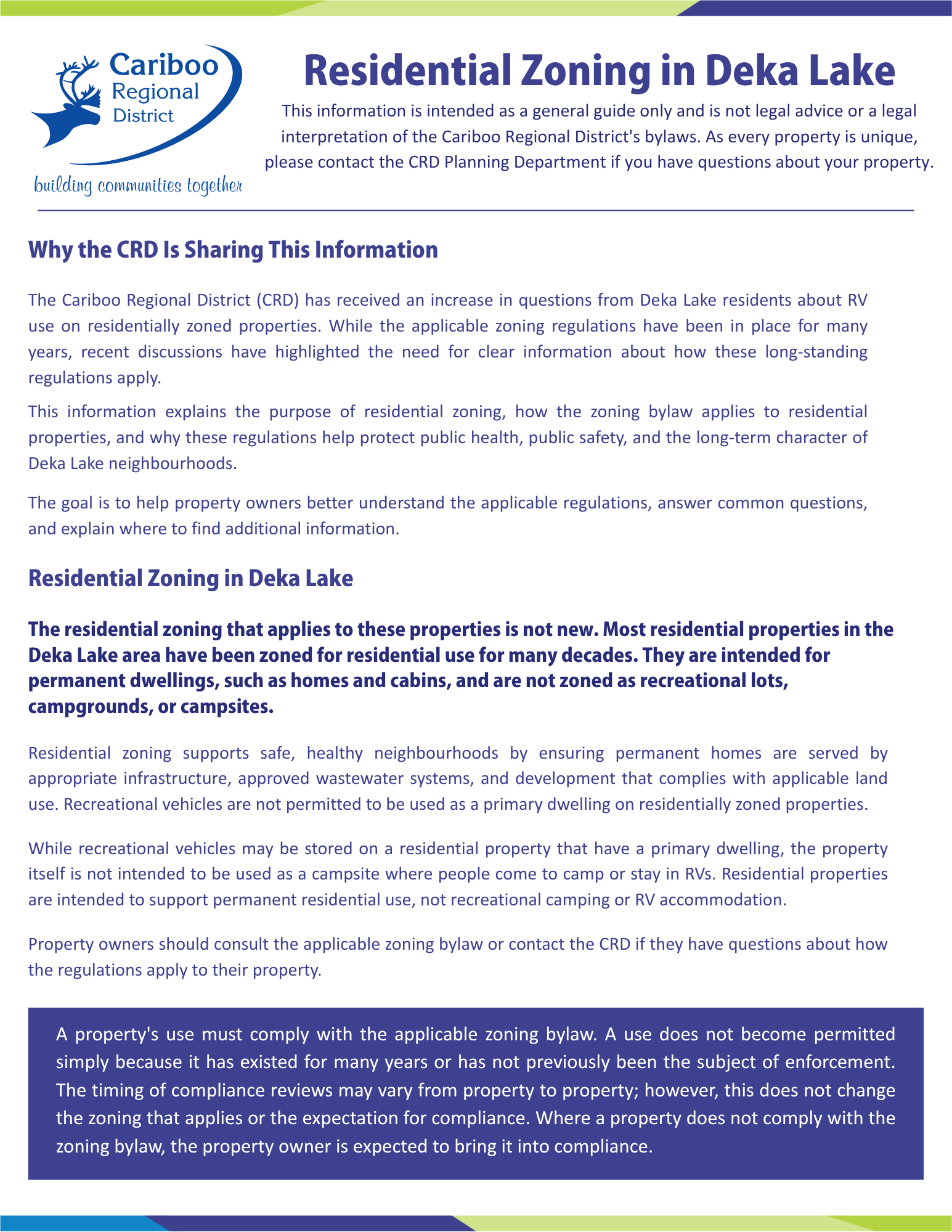
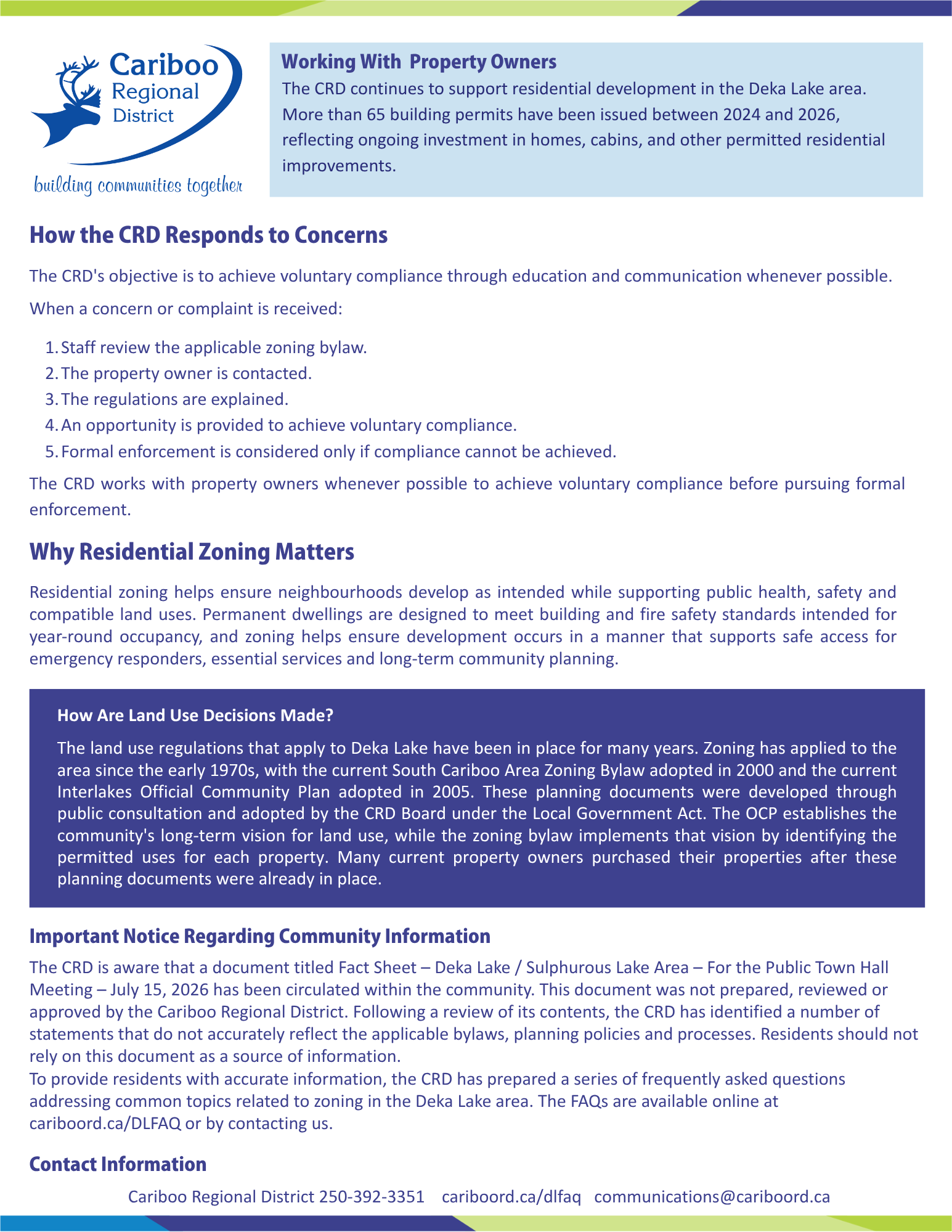
The CRD is aware that a document titled Fact Sheet – Deka Lake / Sulphurous Lake Area – For the Public Town Hall Meeting – July 15, 2026 has been circulated within the community. This document was not prepared, reviewed or approved by the Cariboo Regional District. Following a review of its contents, the CRD has identified a number of statements that do not accurately reflect the applicable bylaws, planning policies and processes. As a result, it should not be relied upon as a source of information regarding CRD bylaws, policies or planning processes.
The following frequently asked questions have been prepared to address a number of statements contained in that document and to provide general information about the applicable regulations. They are not intended to address every property or circumstance, as every property is unique. Residents with questions about their property or specific situation are encouraged to contact CRD staff directly.
About this FAQ
These frequently asked questions provide general information about zoning regulations in the Deka Lake area. They are intended to help property owners better understand the applicable bylaws, planning processes and common questions related to land use.
This FAQ is provided as a general guide only and should not be considered legal advice. Every property is unique. If you have questions about your property or are unsure how the regulations apply to your specific situation, please contact CRD staff. Staff are available to answer your questions and help you understand the applicable regulations.
What zoning applies to most Deka Lake properties?
When were the current zoning regulations adopted?
Zoning has applied to the Deka Lake area since the early 1970s. The current South Cariboo Area Zoning Bylaw (Bylaw No. 3501) was adopted in 2000, replacing earlier zoning bylaws, and the current Interlakes Official Community Plan (Bylaw No. 3906) was adopted in 2005. These planning documents continue to guide land use and development in the Deka Lake area.
Does the Official Community Plan determine what I can do on my property?
No.
An Official Community Plan establishes long-term land use policy, but the zoning bylaw determines what uses are permitted on a property. Both documents are considered when planning applications are reviewed.
Does Residential 1 (R1) zoning allow permanent residential RV use?
No.
The R1 Zone is intended primarily for residential dwellings. An RV is not considered a dwelling under the zoning bylaw, and long-term residential occupancy of an RV is generally not a permitted use.
Can I store an RV on my property?
Yes, in most cases.
An RV may generally be stored on a residential property where there is an existing principal dwelling, provided it complies with the zoning bylaw.
Simply storing an RV is different from using it as a dwelling. Compliance concerns arise when an RV is used for residential occupancy or when structures or additions change the nature of its use.
Why are these regulations enforced?
Zoning bylaws help protect public health and safety, support environmental protection, guide orderly land use and ensure consistent application of land use regulations throughout the region.
Do smaller lots prevent a property from meeting septic or well setback requirements?
No.
Lot size alone does not determine whether a property can meet septic or well setback requirements. Each property is evaluated based on its individual characteristics and the applicable regulations.
Many smaller lots are capable of accommodating compliant septic systems and meeting required setbacks, in British Columbia, the design, installation, or repair of a septic (onsite sewage) system is governed by the Ministry of Health.
Does meeting septic, setback or building requirements mean residential RV use is permitted?
No.
Meeting servicing, setback or building requirements does not, by itself, make residential RV use a permitted use.
Whether a use is permitted is determined by the applicable zoning bylaw.
A building permit authorizes the construction, alteration or addition of buildings and structures that are permitted under the applicable bylaws and comply with the BC Building Code.
A building permit does not authorize a building, structure or land use that is not permitted by the applicable zoning bylaw. In other words, a permit allows you to build something that is already allowed—it does not make a prohibited use or structure permissible.
Please contact the CRD staff with enquires about permits.
Can I obtain a building permit to make my RV compliant?
No.
A building permit authorizes the construction, alteration or addition of buildings and structures that comply with the BC Building Code and applicable bylaws.
A building permit does not authorize a land use that is not permitted by the zoning bylaw, including residential occupancy of an RV where that use is not permitted.
Can I live in my RV while I build a house?
In many cases, yes, while a permitted dwelling is actively under construction.
Where a valid building permit has been issued and construction of the permitted dwelling has commenced, significant progress toward completion must be demonstrated. An RV may be permitted on the property only while the dwelling is under active construction and subject to applicable bylaws and permit conditions. This permission is temporary and ends once occupancy of the permanent residence begins or if construction is substantially delayed or no longer progressing.
Can I apply for a Temporary Use Permit (TUP) to use my RV on my property?
For most Deka Lake properties, no.
For most residential properties in the Deka Lake area, the applicable Official Community Plan does not support Temporary Use Permits for residential RV use.
A Temporary Use Permit is not available as a general solution for residential RV use.
Can I apply to rezone my property or request a variance?
There is currently no zone in the South Cariboo Area Zoning Bylaw that permits residential occupancy of an RV.
Rezoning is intended to change existing use regulations and must be consistent with the Official Community Plan, applicable legislation, and Regional District planning policies. Any rezoning application is considered through a public process, and approval is not automatic.
A Development Variance Permit may vary certain zoning regulations, such as setbacks or siting requirements where permitted by legislation, but it cannot authorize a land use that is prohibited by the zoning bylaw.
If residential RV use is not permitted in the applicable zone, neither a rezoning application nor a Development Variance Permit should be considered a means of authorizing that use.
Is there a recreational residential zone that permits long-term RV use?
The South Cariboo Area Zoning Bylaw does not include a recreational residential zone that permits residential occupancy of an RV. Residential properties must comply with the uses permitted in their applicable zone.
Why are some properties contacted before others?
The timing of compliance reviews varies from property to property based on complaints received, operational priorities and available resources.
This does not change the zoning that applies or the expectation for compliance.
If my property has been used this way for many years, does that make it legal?
No.
A use does not become permitted simply because it has existed for many years or has not previously been the subject of enforcement. A property's use must comply with the applicable zoning bylaw.
Why can't the CRD simply make an exception for my property?
The Regional District administers the zoning bylaw consistently across properties.
While every property is unique and individual circumstances are considered, staff cannot waive or disregard the requirements of the zoning bylaw outside of the planning processes established by legislation.
What does it mean if my property is under a compliance review?
A compliance review means the CRD is assessing whether a property's use or development complies with the applicable bylaws.
A compliance review is not a determination that a bylaw has been violated. It is an opportunity for staff to gather information, explain the applicable regulations, and work with property owners to understand the situation and, where necessary, identify options to achieve compliance.
If a property is found not to comply with the applicable bylaws, the CRD's first approach is to work with the property owner toward voluntary compliance before additional enforcement options.
What happens if my property is not compliant?
The CRD's first approach is to explain the applicable regulations and work with property owners toward voluntary compliance.
Where voluntary compliance cannot be achieved, additional enforcement options may be considered in accordance with Regional District policy and applicable legislation.
Does an education-first approach mean zoning enforcement has stopped?
No.
An education-first approach means the CRD's initial focus is on communicating with property owners to explain the applicable zoning regulations, why compliance is being requested, and what options may be available.
It does not suspend or eliminate enforcement. Property owners are still expected to comply with the applicable zoning bylaw, and where voluntary compliance cannot be achieved, further enforcement action may be considered in accordance with Regional District policy and applicable legislation.
Who can I contact if I have questions about my property?
This FAQ provides general information only. If you have questions about your property or your specific circumstances, please contact CRD staff.